WA transport industry offers practical measures to ease cost-of-living pressures.
The Western Australian transport industry is offering to work with the State
Government on practical, rapidly implementable measures to reduce freight costs
and help ease cost-of-living pressures for Western Australian businesses and
households.
Pressures that were reported today in a CCIWA report published in The Sunday
Times, citing that 60% of West Australian’s being in financial stress.
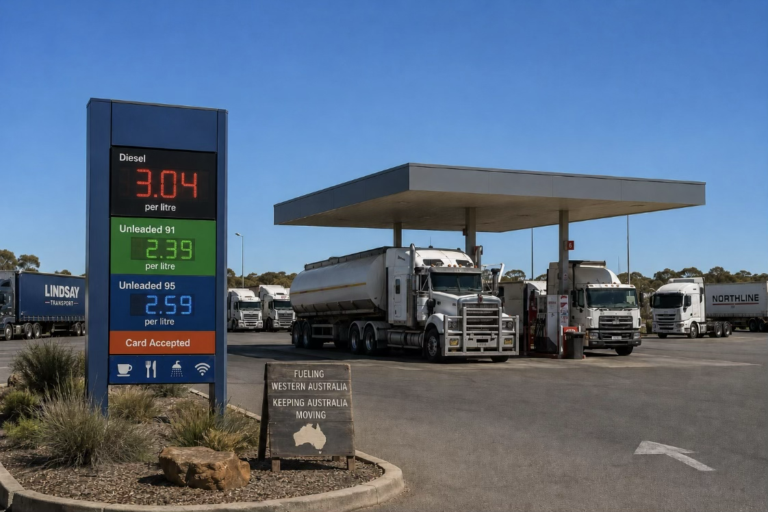
The Western Australia Transport Industry Association (WATIA) says rising fuel prices,
combined with increasing operating costs across the freight sector, are placing
significant pressure on transport operators — costs that ultimately flow through the
supply chain to businesses and consumers.
WATIA’s staff have been talking to stressed operators including one transport
operator who had just paid nearly $6,000 to fill his long-haul truck— a crippling 40%
of the total payment for the load, before other operating costs, insurances, wages
and overheads.
The need for action is becoming increasingly urgent, with the harvest and Christmas
peak freight and a high-risk season this summer on transnational and intrastate
freight routes approaching, combined with uncertainty around fuel prices and supply.
WATIA is proposing to work collaboratively with the State Government to identify and
rapidly implement low-cost productivity measures that can remove unnecessary
costs and delays from Western Australia’s freight network.
Every unnecessary delay, additional kilometre travelled or regulatory barrier adds
cost to the movement of freight. Those costs affect not only transport operators but
almost every Western Australian business and, so ultimately, consumers.
The productivity measures WATIA is seeking to discuss with Government include:
– removing last-mile freight barriers;
– addressing disconnects and inefficiencies across the freight network;
– reducing intermodal delays; and
– eliminating ineffective and unnecessary red tape.
Improving freight productivity would reduce fuel consumption, lower operating costs
and ease pressure on drivers, while helping contain the transport costs embedded in
the price of goods across Western Australia.
WATIA is also offering to partner with the State Government on industry-led
initiatives to accelerate the electrification of light and medium freight vehicles
operating in the metropolitan area, reducing the sector’s exposure to volatile fuel
prices over the longer term.
The State Government has previously demonstrated that practical regulatory changes
can deliver immediate productivity benefits, including initiatives allowing more
efficient heavy vehicle combinations to transport agricultural inputs and supply
regional communities along the Great Northern Highway.
WATIA believes a similar collaborative and pragmatic approach can deliver further
productivity improvements across the freight network.
With Western Australia entering one of its busiest freight periods of the year, the
industry is ready to work with Government to identify measures that can be
implemented quickly and at minimal cost.
Reducing unnecessary freight costs is not simply an issue for the transport industry. A
more efficient freight network benefits every Western Australian business and
household that relies on goods being moved safely, reliably and affordably across the
State.